


Construction & Operational Permits

Fire Protection & Life Safety System Construction Permits

At the Bryan Fire Marshal’s Office, we are committed to ensuring that all fire and life safety systems are designed, installed and maintained in accordance with the highest standards of safety and code compliance. Through our permitting, plan review and acceptance testing processes, we work diligently to safeguard lives, protect property and support the responsible growth of our community.

These processes are critical to verifying that fire sprinkler systems, alarms, suppression systems and related infrastructure function correctly when they are needed most. Whether it’s a new development or a renovation, thorough review and testing help prevent costly failures and ensure timely emergency response capabilities.

We proudly fulfill our mission of providing “Service, Above and Beyond” through:

  • Quality customer service that helps contractors and developers navigate code requirements with clarity and efficiency
  • Public education that promotes awareness of life safety principles
  • Teamwork with city departments, businesses and citizens to foster a collaborative approach to fire prevention
  • Building positive relationships that support a safe and business-friendly environment, reflecting the entrepreneurial spirit of the City of Bryan

By partnering with property owners, design professionals and contractors, we aim to create a city where safety and progress go hand in hand. Your cooperation in the permitting and inspection process plays a vital role in helping us achieve this goal.

Code Adoption & Amendments

The City of Bryan has adopted the 2021 edition of the International Fire Code (IFC), including Appendices B, C, D, E, F, and G, as published by the International Code Council. The code is adopted to the same extent as though fully set forth herein and is subject to the omissions, additions, supplements, and amendments contained in the City of Bryan Code of Ordinances, Chapter 2, Article II: Fire Prevention Code.

In addition to the adopted fire code, projects within the City of Bryan are also subject to applicable provisions contained within the Bryan / College Station Unified Design Guidelines Manual, Technical Specifications, and Standard Construction Details. These documents establish regional standards for site development, infrastructure, utilities, access, and construction practices and should be consulted when designing projects that involve fire department access roads, water supply infrastructure, hydrant placement, site grading, and other development features affecting fire protection and emergency access.

Design professionals and contractors are responsible for ensuring that all submitted plans and constructed work comply with the International Fire Code, City of Bryan amendments, and applicable Unified Design Guidelines and construction standards.

NFPA Adoptions

The adopted editions of National Fire Protection Association (NFPA) standards, enforced by the City of Bryan, are identified within 2021 IFC Chapter 80: Referenced Standards. Where an NFPA standard is referenced by the IFC, the edition listed in Chapter 80 shall be considered the enforceable edition unless otherwise modified by local ordinance.

Design professionals should consult Chapter 80 to verify the applicable edition of each referenced NFPA standard during system design and plan preparation.

Construction Permit Fees

Construction permit fees are based on the scope of work and may vary depending on factors such as new construction or modifications to existing systems, as well as the number components within the system. The permit fee includes the cost of plan review and acceptance testing inspections. Additional fees may be assessed for reinspections or repeat inspections due to non-compliance. Final fee amounts will be determined during the plan review process to ensure accurate assessment. Applicants are encouraged to review the current fee schedule prior to submittal.

Phased Construction & Multiple System Permits

When a project includes multiple fire protection systems that will not be constructed and commissioned simultaneously, and/or when phased construction is approved, each system or phase may require a separate permit application to ensure the installation status of each phase is properly tracked, inspected, and documented.

Each permit application shall clearly identify and reflect the approved phase designation. The phase name used on the permit shall match the approved phasing plan to ensure accurate inspection scheduling, acceptance testing and project closeout documentation.

Construction Permit Application Review Process

Once the fire protection system permit application is submitted, it will be reviewed for completeness and assigned to a plans reviewer. Please allow up to 14 business days for the review to be completed. All correspondence regarding revisions or additional information will be directed only to the email address and phone number provided on the application. Failure to respond in a timely manner may result in delays to the overall review and approval process.

Upon approval, applicants will be notified of the total fees due. The permit will be issued once payment is received, and digitally stamped, approved plans will be delivered to the applicant.

Applicant Responsibilities & Permit Contact Information

The individual listed on the permit as the Applicant will serve as the primary contact for the project. The applicant is the person responsible for managing the permit throughout the plan review and inspection process.

Applicants have full access within the permitting system and will be able to view and manage all pertinent information related to the permit, including:

  • Permit status and plan review comments
  • Correspondence from the Fire Marshal’s Office
  • Inspection requests and inspection results
  • Automated notifications generated by the system

The applicant is responsible for coordinating project communications and requesting and scheduling required inspections and acceptance testing.

As the project progresses, particularly when it transitions from the plan review phase to the inspection and acceptance testing phase, a request may be submitted to change the designated applicant if another individual becomes the most appropriate project contact (for example, when responsibility transitions from the design professional to the installing contractor).

Additional stakeholders may also be added to the permit as “Additional Contacts.” These individuals are authorized to view permit activity and will be able to see:

  • Permit status
  • Plan review comments
  • Inspection comments and results

However, Additional Contacts cannot request inspections and will not receive automated system notifications.

It is essential that the individual listed as the applicant is the most appropriate contact based on the project’s scope and responsibilities.

Please do not provide generic office contact information (such as a receptionist, general office email or main phone number) unless it leads directly to the individual responsible for managing the permit. Accurate contact information is necessary to avoid delays in communication, plan review coordination and inspection scheduling.

This process helps ensure smooth coordination, timely approvals and effective communication between the Bryan Fire Department Fire Marshal’s Office and the professionals responsible for fire and life safety systems within the City of Bryan.

Fire Protection & Life Safety Submittal Guides

Thank you for choosing to invest in the City of Bryan and in our community. Your commitment to growth and development strengthens our city and contributes to the quality of life for our residents, businesses and visitors.

The purpose of these Fire & Life Safety Submittal Guides is to support the City of Bryan’s commitment to providing above and beyond customer service by helping property owners, designers and contractors navigate the fire and life safety review process as efficiently as possible.

These guides are intended to serve as a practical resource that complements the information available through the City’s Development Services Department and the adopted codes and standards. While the International Fire Code, International Building Code and referenced NFPA standards establish the technical requirements for fire and life safety systems, many provisions within those documents grant the fire code official discretionary authority to interpret or approve certain conditions.

Accordingly, these guides are designed to:

  • Clarify local expectations in areas where the adopted codes or local amendments allow discretion by the fire code official.
  • Identify commonly missed requirements that frequently result in plan review corrections, project delays or costly rework during construction.
  • Provide practical guidance to help design professionals and contractors submit complete, code-compliant documents the first time.
  • Promote consistency and transparency in how fire and life safety requirements are reviewed and applied within the City of Bryan.

By following the guidance provided in these documents, applicants can help reduce unnecessary plan review comments, avoid construction delays and ensure a smoother path through permitting, inspections and final Certificate of Occupancy (CO) approval.

We appreciate your investment in Bryan and look forward to partnering with you to make your project a success, not only during construction but throughout the long-term operation and safety of your property or business.

warning sign

Important Disclaimer

Submittal guides are subject to revision and update as adopted codes, local amendments and departmental procedures change. In addition, the Bryan Fire Department Fire Marshal’s Office continuously evaluates and improves its plan review, inspection and acceptance testing processes. As a result, these guides may be updated periodically to improve clarity, address commonly encountered issues and incorporate process improvements.

Applicants are responsible for ensuring they are using the most current version of each submittal guide at the time of application. Always download the latest version of this document or reference the online version associated with the project to verify current requirements.

System Specific Submittal Guides

Fire & Life Safety Construction Submittal Guide for New & Existing Construction

The Fire & Life Safety Construction Submittal Guide for New & Existing Construction provides general guidance on International Fire Code (IFC) requirements that apply to construction projects within the City of Bryan. This guide addresses fire and life safety provisions that commonly affect both new construction and renovation or remodeling projects.

This document should be referenced for all projects requiring a building permit, as it outlines fire code considerations that must be addressed during the design, plan review and construction phases. The guide highlights requirements that are frequently overlooked and provides clarification on how IFC provisions are typically applied during project review.

Additional system-specific guidance for fire protection and life safety systems is provided elsewhere on this website. Designers and contractors working on systems such as fire alarm systems, fire sprinkler systems, standpipe systems and other specialized fire protection features should reference the submittal guides specific to each system type as defined by the International Fire Code (IFC).

Design professionals, contractors and property owners should review this guide in conjunction with the adopted codes, local amendments and Development Services permitting requirements to help ensure projects are designed and submitted in compliance with applicable fire and life safety standards.
Fire Alarm and Detection Systems Submittal Requirements

Design professionals are responsible for ensuring that all fire alarm and detection system designs comply with all adopted codes, referenced standards and local amendments enforced by the City of Bryan.

The information provided in this submittal guide is intended to assist designers by clarifying local expectations and situations where the fire code official may exercise discretion during the plan review, installation and acceptance testing process. The guide also highlights items that commonly create confusion or delays during project review.

Where specific guidance is not provided in these documents, designers shall follow the adopted codes, referenced standards and applicable local amendments.

Design professionals are encouraged to communicate with Fire Marshal’s Office plan reviewers during the design process when questions arise. We also welcome suggestions from designers and contractors that may help improve the plan review, installation and acceptance testing processes for fire alarm and detection systems within the City of Bryan.

View the full fire alarm and detection systems submittal requirements document here.

Automatic Sprinkler Systems

Design professionals are responsible for ensuring that all automatic fire sprinkler system designs comply with all adopted codes, referenced standards and local amendments enforced by the City of Bryan.

This submittal guide is intended to assist designers by clarifying local expectations and situations where the fire code official may exercise discretion during the plan review, installation and acceptance testing process for sprinkler systems. The guide also highlights requirements and submittal items that are commonly overlooked and can result in review comments, delays or additional costs during construction.

Where specific guidance is not provided in this document, designers shall follow the adopted codes, referenced standards and applicable local amendments, including the applicable NFPA sprinkler system standards.

Design professionals are encouraged to communicate with Fire Marshal’s Office plan reviewers during the design process when questions arise. We also welcome suggestions from designers and contractors that may help improve the plan review, installation and acceptance testing processes for automatic fire sprinkler systems within the City of Bryan.

Disclaimer: This submittal guide may be updated periodically as adopted codes, local amendments and departmental procedures evolve. Applicants are responsible for ensuring they are using the most current version of this document when preparing permit applications.

View the full automatic fire sprinkler system submittal requirements document here.

Fire Protection Water Supplies

Design professionals are responsible for ensuring that all fire protection water supply system designs comply with all adopted codes, referenced standards and local amendments enforced by the City of Bryan. This includes applicable provisions of the International Fire Code (IFC), referenced NFPA standards, and the Bryan–College Station Unified Design Guidelines, Technical Specifications and Standard Construction Details, which establish local requirements for water infrastructure and fire protection water supply systems.

This submittal guide is intended to assist designers by clarifying local expectations and situations where the fire code official may exercise discretion during the plan review, installation and acceptance testing process for fire protection water supplies. The guide also highlights requirements and submittal items that are commonly overlooked and can result in review comments, delays or additional costs during construction.

Where specific guidance is not provided in this document, designers shall follow the adopted codes, referenced standards, applicable local amendments and the Bryan–College Station Unified Design Guidelines governing water system infrastructure and fire protection water supply installations.

Design professionals are encouraged to communicate with Fire Marshal’s Office plan reviewers and Development Services staff during the design process when questions arise. We also welcome suggestions from designers and contractors that may help improve the plan review, installation and acceptance testing processes related to fire protection water supply systems within the City of Bryan.

Disclaimer: This submittal guide may be updated periodically as adopted codes, local amendments and departmental procedures evolve. Applicants are responsible for ensuring they are using the most current version of this document when preparing permit applications.

Alternative Automatic Fire Extinguishing Systems

Design professionals are responsible for ensuring that all alternative automatic fire extinguishing system designs comply with all adopted codes, referenced standards and local amendments enforced by the City of Bryan. This includes applicable provisions of the International Fire Code (IFC) and the relevant NFPA standards governing specialized fire suppression systems.

This submittal guide is intended to assist designers by clarifying local expectations and situations where the fire code official may exercise discretion during the plan review, installation and acceptance testing process for alternative fire extinguishing systems. The guide also highlights requirements and submittal items that are commonly overlooked and can result in review comments, delays or additional costs during construction.
Where specific guidance is not provided in this document, designers shall follow the adopted codes, referenced standards and applicable local amendments.

Design professionals are encouraged to communicate with Fire Marshal’s Office plan reviewers during the design process when questions arise. We also welcome suggestions from designers and contractors that may help improve the plan review, installation and acceptance testing processes for alternative automatic fire extinguishing systems within the City of Bryan.

Disclaimer: This submittal guide may be updated periodically as adopted codes, local amendments and departmental procedures evolve. Applicants are responsible for ensuring they are using the most current version of this document when preparing permit applications.

Electronically Controlled Egress Systems

Design professionals are responsible for ensuring that all electronically controlled egress system designs comply with all adopted codes, referenced standards and local amendments enforced by the City of Bryan. This includes applicable provisions of the International Building Code (IBC), International Fire Code (IFC) and referenced standards governing electrical locking systems and means of egress.

This submittal guide is intended to assist designers by clarifying local expectations and situations where the fire code official may exercise discretion during the plan review, installation and acceptance testing process for electronically controlled egress systems. The guide also highlights requirements and coordination items that are commonly overlooked and can result in plan review corrections, field modifications or delays during construction.

Where specific guidance is not provided in this document, designers shall follow the adopted codes, referenced standards and applicable local amendments.

Design professionals are encouraged to coordinate early with Fire Marshal’s Office plan reviewers and other design disciplines when electronically controlled egress systems are proposed. We also welcome suggestions from designers and contractors that may help improve the plan review, installation and acceptance testing processes for these systems within the City of Bryan.

Disclaimer: This submittal guide may be updated periodically as adopted codes, local amendments and departmental procedures evolve. Applicants are responsible for ensuring they are using the most current version of this document when preparing permit applications.

View the full electronically controlled egress system submittal requirements document here.

Emergency Responder Communication Coverage Systems

Design professionals are responsible for ensuring that all Emergency Responder Communication Coverage Systems (ERRCS) are designed and installed in compliance with all adopted codes, referenced standards and local amendments enforced by the City of Bryan. This includes applicable provisions of the International Fire Code (IFC) and referenced NFPA standards governing in-building emergency responder radio communication systems.

This submittal guide is intended to assist designers by clarifying local expectations and situations where the fire code official may exercise discretion during the plan review, installation and acceptance testing process for ERRCS installations. The guide also highlights requirements and coordination items that are commonly overlooked and can result in plan review corrections, construction delays or additional testing requirements.

Where specific guidance is not provided in this document, designers shall follow the adopted codes, referenced standards and applicable local amendments.

Design professionals are encouraged to coordinate early with Fire Marshal’s Office plan reviewers and system integrators when ERRCS systems are proposed. We also welcome suggestions from designers, contractors and system providers that may help improve the plan review, installation and acceptance testing processes for emergency responder communication coverage systems within the City of Bryan.

Disclaimer: This submittal guide may be updated periodically as adopted codes, local amendments and departmental procedures evolve. Applicants are responsible for ensuring they are using the most current version of this document when preparing permit applications.

View the full emergency responder communication coverage system submittal requirements document here.

Gates, Barricades & Perimeter Fencing

Design professionals, developers and contractors are responsible for ensuring that all gates, barricades and perimeter fencing installations comply with all adopted codes, referenced standards and local amendments enforced by the City of Bryan. This includes applicable provisions of the International Fire Code (IFC) related to fire apparatus access roads, fire department access and emergency vehicle operations.

This submittal guide is intended to assist project teams by clarifying local expectations and situations where the fire code official may exercise discretion when evaluating gates, barricades and perimeter fencing that affect fire department access. The guide also highlights requirements and coordination issues that are commonly overlooked and can result in plan review corrections, construction delays or required field modifications.

Where specific guidance is not provided in this document, designers and contractors shall follow the adopted codes, referenced standards and applicable local amendments.

Design professionals, developers and contractors are encouraged to coordinate early with Fire Marshal’s Office plan reviewers when proposing gated access, security barriers or perimeter fencing that may affect fire department access. We also welcome suggestions that may help improve the plan review, installation and inspection processes related to fire apparatus access within the City of Bryan.

Disclaimer: This submittal guide may be updated periodically as adopted codes, local amendments and departmental procedures evolve. Applicants are responsible for ensuring they are using the most current version of this document when preparing permit applications.

View the full gates, barricades and perimeter fencing submittal requirements document here.

Energy Storage Systems

The 2021 International Fire Code (IFC) Section 1207 regulates stationary and mobile Energy Storage Systems (ESS) such as battery energy storage installations. When the total energy storage capacity of a system exceeds certain thresholds, the installation becomes subject to additional fire and life safety requirements and permits from the Fire Marshal’s Office are required.

Energy capacity is based on the total nameplate storage capacity (kWh) of the system, not the usable energy rating.

In addition to Fire Department permits, most ESS installations will also require permits from the City of Bryan Development Services Department, such as building, electrical or site permits, depending on the scope of work. Applicants are responsible for coordinating all required permits and approvals associated with the project. Fire Department approval does not replace or eliminate permitting requirements administered by Development Services or other City departments.

When an ESS installation exceeds the threshold quantities listed below, the following Fire Department permits are typically required:

  • Construction Permit – Required for installation of stationary ESS systems and for mobile ESS charging or storage installations.
  • Operational Permit – Required for the operation of stationary ESS installations or mobile ESS deployment operations.

Note: Energy Storage Systems installed in Group R-3 and R-4 occupancies (such as one- and two-family dwellings) are regulated under IFC Section 1207.11 and may follow different requirements.
Energy Storage System Permit Thresholds (IFC Table 1207.1.1)

ESS Technology Permit Requirements
ESS Technology Permit Required When System Capacity Exceeds
Capacitor Energy Storage Systems 3 kWh
Flow Batteries (vanadium, zinc-bromine, etc.) 20 kWh
Lithium-ion Batteries 20 kWh
Lead-acid Batteries (all types) 70 kWh
Nickel-metal hydride (Ni-MH) 70 kWh
Nickel-cadmium (Ni-Cd) 70 kWh
Other Battery Technologies 10 kWh
Other Electrochemical ESS Technologies 3 kWh

Important Notes

  • Energy capacity refers to the total storage capacity shown on the equipment nameplate, not the usable energy rating.
  • For systems rated in amp-hours, energy capacity is calculated as:
    Voltage × Amp-hours ÷ 1,000 = kWh
  • For lead-acid batteries, 50 gallons of electrolyte is considered equivalent to 70 kWh.

Design professionals, installers and property owners should review the Energy Storage Systems Submittal Guide, the adopted International Fire Code, and applicable Development Services permitting requirements when proposing ESS installations within the City of Bryan. Early coordination with the Fire Marshal’s Office and Development Services is strongly encouraged to help ensure compliance and avoid project delays.

High-Piled Combustible Storage

The International Fire Code (IFC) regulates high-piled combustible storage due to the increased fire hazards associated with storing large quantities of combustible materials. A construction permit from the Fire Marshal’s Office is required when a building contains more than 500 square feet of high-piled combustible storage, including storage areas and operating aisles.

High-piled combustible storage generally occurs when combustible materials are stored more than 12 feet in height in piles, on pallets, racks or shelving. In some cases, the fire code official may classify certain high-hazard commodities as high-piled storage when the storage height exceeds 6 feet, including materials such as:

  • Rubber tires
  • Group A plastics
  • Flammable liquids
  • Idle pallets
  • Similar high-hazard commodities

A high-piled storage area includes the entire storage footprint, including operating aisles used to access stored materials.

Local Amendment – City of Bryan

Under the City of Bryan amendment, certain buildings are considered high-piled storage based on building size and clear height, even if the specific storage arrangement has not yet been identified.

Any building that meets the following conditions will be considered high-piled storage:

  • Group S occupancy or speculative warehouse, and
  • Greater than 12,000 square feet, and
  • Clear ceiling height greater than 14 feet

When the specific commodity or storage arrangement is unknown, fire protection and life safety systems must be designed for Class IV commodities at the maximum possible storage height.

High-Piled Storage Permit Threshold

High-Piled Storage Permit Threshold
Condition Permit Required
High-piled combustible storage area greater than 500 sq. ft. (including aisles) Yes – Construction Permit Required
Storage height over 12 ft for typical combustible commodities May qualify as high-piled storage
High-hazard commodities over 6 ft (rubber tires, Group A plastics, flammable liquids, idle pallets, etc.) May be classified as high-piled storage by the Fire Code Official
Routine maintenance of existing storage systems Permit not required

Coordination with Development Services

High-piled storage installations often require additional permits from the City of Bryan Development Services Department, such as building permits, fire protection system permits or modifications to existing life safety systems. Applicants are responsible for coordinating all required permits and approvals associated with the project.

Early coordination with the Fire Marshal’s Office and Development Services is strongly encouraged when planning warehouse or storage facilities to help ensure compliance with fire and life safety requirements and avoid costly redesigns or construction delays.

View the full high-piled combustible storage submittal requirements document here.

Flammable and Combustible Liquid Use and Storage

Design professionals, owners and contractors are responsible for ensuring that all underground storage tank (UST) systems for flammable and combustible liquids comply with all adopted codes, referenced standards and local amendments enforced by the City of Bryan. This includes applicable provisions of the International Fire Code (IFC) as well as regulations administered by the Texas Commission on Environmental Quality (TCEQ) governing underground storage tank systems.

This submittal guide is intended to assist applicants by clarifying local expectations and situations where the fire code official may exercise discretion during the plan review, installation and inspection process for UST installations. The guide also highlights requirements and coordination items that are commonly overlooked and can result in plan review corrections, construction delays or additional costs during construction.

Where specific guidance is not provided in this document, applicants shall follow the adopted codes, referenced standards, applicable local amendments and TCEQ regulations governing underground storage tank systems.

UST installations typically require multiple permits and approvals, including permits issued by the City of Bryan Development Services Department and regulatory compliance with TCEQ UST program requirements. Applicants are responsible for coordinating all required permits, approvals and inspections associated with the project.

Design professionals and contractors are encouraged to coordinate early with the Fire Marshal’s Office and Development Services when proposing new UST installations or modifications to existing systems. Early coordination can help ensure compliance with fire and environmental safety requirements and avoid costly project delays.

Disclaimer: This submittal guide may be updated periodically as adopted codes, local amendments and departmental procedures evolve. Applicants are responsible for ensuring they are using the most current version of this document when preparing permit applications.

Inspection Readiness & Scheduling Policy

To ensure timely and efficient service for all customers, acceptance testing inspections shall not be scheduled until all associated work has been completed and verified as code-compliant by the contractor. By requesting an inspection, the applicant affirms that all components related to the inspection are fully installed, functional, and ready for review at the scheduled time.

For systems requiring a Texas State Fire Marshal (TDI) Installation Certificate, the completed certificate shall be submitted to the Fire Marshal’s Office prior to scheduling or conducting the witnessed acceptance test. The form shall be fully completed and signed by both the owner (or owner’s representative) and the installing contractor. Submission of this document certifies that all system components have been properly installed and pretested in accordance with applicable standards before the witnessed acceptance testing occurs.

If the work is found to be incomplete, required documentation has not been provided, or the system is not fully operational at the time of inspection, the inspection may be immediately terminated, and a reinspection fee will be assessed. Rescheduling will be based on Fire Marshal’s Office availability and may result in significant project delays.

Additionally, appointment cancellations made with less than one full business day notice may be subject to additional fees.

Operational Permits

Mobile Food Vendor Licensing Update

During the 89th Texas Legislative Session, Texas House Bill 2844 was adopted, creating a statewide licensing process for mobile food vendors.

Effective July 1, 2026, municipalities may no longer require mobile food vendors to obtain a separate local permit for operation when the vendor is properly licensed by the State of Texas. Mobile food vendors are now required to obtain and maintain the appropriate license through the Texas Department of State Health Services.

Important Fire Code Information for the City of Bryan

While a separate local operating permit for the mobile food unit is no longer required under House Bill 2844, vendors must still comply with all applicable fire and life safety regulations.

Specifically, if a Type I hood and commercial cooking system is installed within the City of Bryan, the installation remains subject to local permitting requirements. A permit for a Commercial Cooking System is required prior to installation, modification, or replacement of:

  • Type I hoods
  • Fire suppression systems protecting cooking equipment
  • Associated exhaust duct systems
  • Related fuel or electrical connections

These permits ensure compliance with the International Fire Code and applicable NFPA standards.

Please refer to the Fire & Life Safety Systems section of our website for Commercial Cooking System permit submittal requirements and inspection procedures.

For questions regarding fire code compliance within the City of Bryan, please contact the Bryan Fire Marshal’s Office.

Opening Burning Permits

Any fire within the Bryan City Limit that does not qualify as a Recreational Fire, Portable Outdoor Fireplace or Open-Flame Cooking Device will require an open burning permit.

Pyrotechnic Display and Flame Effects Permit

A Pyrotechnic Display or Flame Effects Permit is required for any public or private event that includes:

  • Outdoor aerial fireworks or proximate pyrotechnics
  • Flame effects or open flame used in theatrical, concert, or public performances
  • Special effects involving flammable gases, liquids, or solids
  • Indoor pyrotechnic or flame presentations

Permits are required regardless of audience size or event location and must be issued by the Bryan Fire Marshal’s Office prior to any setup, testing, or performance.

View the full pyrotechnic special effects submittal requirements document here.

Licensing Requirements

Per Texas Occupations Code §2154 and Title 28 TAC §34.800–§34.826, the following apply:

  • The operator must hold a valid Texas Pyrotechnic Special Effects Operator License issued by the Texas Department of Insurance (State Fire Marshal’s Office).
  • The company conducting the display must hold a valid Pyrotechnic or Special Effects Company License.
  • A copy of both licenses must be uploaded with the permit application.
  • Operators shall have their licenses present on site during setup, testing, and performance.

The appropriate Texas license must be held by the contractor performing the work:

Licensing Requirements by System Type
System Type Regulating Agency Required License
Fire alarm or sprinkler-connected locks Texas Department of Insurance (TDI) – State Fire Marshal's Office Fire Alarm Contractor (Type A or Type B)
Stand-alone access control or egress systems Texas Department of Public Safety (DPS) – Regulatory Services Division Electronic Access Control Installer / Company License
Integrated access + fire alarm system Both TDI and DPS Dual licensing or subcontract arrangement

All contractors must be registered with Citizenserve Contractor Registration.

Contractors or technicians performing installation, testing, or maintenance of public safety radio communications equipment, including fire department radio systems, signal boosters, and emergency responder radio coverage systems (ERRCS), must hold a valid Federal Communications Commission (FCC) General Radio Operator License (GROL).

Installers of automated vehicular gates located across designated fire apparatus access roads shall demonstrate competency in the installation of gate operators and assemblies in accordance with UL 325, ASTM F2200, and the 2021 International Fire Code.

Acceptable documentation demonstrating installer competency shall include one of the following:

  1. Certified Gate Automation Technician (CGAT) credential issued by the American Fence Association; or
  2. Manufacturer certification documentation verifying the installer has completed formal training specific to the gate operator model being installed; or
  3. Alternative documentation demonstrating installer competency, which may include proof of formal training, documented experience with similar installations, or other evidence acceptable to the Fire Code Official.

The Fire Code Official is authorized to require submission of such documentation prior to permit approval or final acceptance inspection.

Failure to provide documentation demonstrating installer competency may result in permit hold, failed inspection, or denial of approval until compliance is verified.

Design, installation, modification and service of fire alarm and detection systems within the City of Bryan must be performed by companies and individuals licensed by the Texas Department of Insurance (TDI), State Fire Marshal’s Office, in accordance with Texas Insurance Code Chapter 6002 and 28 Texas Administrative Code Chapter 34.

The company performing the work must hold a valid Fire Alarm Certificate of Registration issued by the State Fire Marshal’s Office. System planning, installation and service must be performed by appropriately licensed individuals employed by the registered company.

Typical licensing requirements include:

  • Fire Alarm Technician (FAL): Authorized to install, service, inspect and maintain fire alarm systems under the supervision of the registered company.
  • Fire Alarm Planning Superintendent (APS): Authorized to plan and supervise the installation of fire alarm systems.

Fire alarm system plans must be prepared by a licensed Alarm Planning Superintendent (APS) or a Texas licensed professional engineer, where applicable.

The licensed contractor responsible for the work must be listed as the permit applicant, and license information may be verified by the Fire Marshal’s Office prior to permit issuance or approval of the installation.

All design, installation, modification and service of automatic fire sprinkler systems in the City of Bryan must be performed by companies and individuals licensed by the Texas Department of Insurance (TDI), State Fire Marshal’s Office, in accordance with Texas Insurance Code Chapter 6003 and 28 TAC Chapter 34.

The contracting company performing the work must hold a valid Texas Fire Sprinkler Contractor License, and system plans must be prepared by or under the supervision of a licensed Responsible Managing Employee (RME-G) or other authorized design professional.

The licensed contractor responsible for the work must be listed as the permit applicant, and license information may be verified by the Fire Marshal’s Office prior to permit issuance or approval of the installation.

Installation, modification and testing of fire protection water supply systems, including underground fire mains and related fire sprinkler system supply piping, must be performed by companies and individuals licensed by the Texas Department of Insurance (TDI), State Fire Marshal’s Office, in accordance with Texas Insurance Code Chapter 6003 and 28 TAC Chapter 34.

The contracting company performing underground fire line work must hold a valid Texas Fire Sprinkler Contractor License, and the work must be performed under the supervision of a Responsible Managing Employee – Underground (RME-U) as required by the State Fire Marshal’s Office.

Where the underground fire main connects to an automatic fire sprinkler system, coordination with the licensed sprinkler contractor responsible for the system installation may also be required.

The licensed contractor responsible for the work must be listed as the permit applicant, and license information may be verified by the Fire Marshal’s Office prior to permit issuance or approval of the installation.

Design, installation, modification and service of alternative automatic fire extinguishing systems within the City of Bryan must be performed by companies and individuals licensed by the Texas Department of Insurance (TDI), State Fire Marshal’s Office, in accordance with Texas Insurance Code Chapter 6001 and 28 Texas Administrative Code Chapter 34.500.

The contracting company performing the work must hold a valid Fire Extinguisher Certificate of Registration issued by the State Fire Marshal’s Office. Work on fixed fire extinguishing systems must be performed by appropriately licensed individuals employed by the registered company.

Typical licensing requirements include:

  • Type A (FEL-A) – Fixed System License: Permits installation, certification and servicing of pre-engineered fixed fire extinguishing systems and portable extinguishers.
  • Type PL – Planning License (EPL): Permits planning, installing, certifying or servicing fixed fire extinguisher systems and portable extinguishers.
  • Type K – Kitchen Cooking Systems License (FEL-K): Permits installation, certification and servicing of pre-engineered kitchen hood fire suppression systems. 


Fixed fire extinguishing systems that are not pre-engineered must be planned by a Type PL licensee or a licensed professional engineer, and installation or servicing must be performed by or supervised by a properly licensed individual. 


The licensed contractor responsible for the work must be listed as the permit applicant, and license information may be verified by the Fire Marshal’s Office prior to permit issuance or system approval.

Companies performing commercial kitchen exhaust hood cleaning services within the City of Bryan must be registered with the Bryan Fire Department Fire Marshal’s Office prior to conducting work.

Contractors must meet the qualifications established in NFPA 96 (2021 Edition): Standard for Ventilation Control and Fire Protection of Commercial Cooking Operations. Compliance may be demonstrated through recognized credentialing organizations such as the International Kitchen Exhaust Cleaning Association (IKECA) or the Power Washers of North America (PWNA).

All credentials must be current and valid for both the company and each employee performing work within the City of Bryan.

There is no fee to register at this time. However, beginning Jan. 1, 2026, any company performing commercial hood cleaning services within the City of Bryan without being properly registered will be considered in violation of the Fire Code and may be subject to enforcement action or citation.

In addition to credentialing and registration requirements, contractors must comply with the inspection, documentation and notification requirements of NFPA 96 (2021 edition) when performing cleaning and maintenance of commercial kitchen exhaust systems.

Installation, repair, modification and removal of flammable and combustible liquid underground storage tank (UST) systems within the City of Bryan must be performed by contractors licensed by the Texas Commission on Environmental Quality (TCEQ) in accordance with Texas Administrative Code (30 TAC) Chapter 334 – Underground and Aboveground Storage Tanks.

Companies performing regulated UST work must hold a valid TCEQ UST Contractor Registration and employ individuals who hold the appropriate TCEQ UST Installer License for the type of work being performed. Licensed installers are responsible for ensuring that installation, modification and repair of UST systems comply with applicable TCEQ regulations, manufacturer requirements and applicable fire code provisions.

Typical licensing requirements include:

  • UST Contractor Registration issued by TCEQ for companies performing regulated UST work.
  • UST Installer License (Class A or Class B) issued by TCEQ for individuals installing or repairing UST systems and associated equipment.

The licensed contractor responsible for the work must be listed as the permit applicant, and license information may be verified by the Fire Marshal’s Office prior to permit issuance or approval of the installation. Applicants are also responsible for coordinating any required approvals, inspections or notifications with TCEQ and the City of Bryan Development Services Department as applicable.

Additional Fire Guidelines & Regulations

Outdoor fires where the fuel being burned is not contained in an approved container AND has a total fuel area of three feet or less in diameter and two feet or less in height for pleasure, religious, ceremonial, cooking, warmth or similar purposes.

  • Shall not be conducted within 25ft of a structure or combustible material.
  • Conditions that could cause a fire to spread within 25ft of a structure shall be eliminated prior to ignition.
  • Recreational Fires are prohibited when a “Burn Ban” is in effect

Outside Fire Guidelines per City of Bryan Ordinance Chapter 42 & IFC 2021 Chapter 3

  • Recreational fires may not contain electrical insulation, treated lumber, plastics, construction or demolition materials not made of wood, heavy oils, asphaltic materials, potentially explosive materials, chemical wastes, or items containing natural or synthetic rubber
  • Shall not be conducted within 25 feet (15 feet for approved portable fireplaces) of a structure or combustible material.
  • All recreational and portable outdoor fireplaces shall be constantly attended until the fire is extinguished.
  • A minimum of one 4-A portable fire extinguisher OR other approved on-site extinguishing equipment, such as dirt, sand, water barrel, garden hose or water truck shall be available for immediate use.

Solid-fuel-burning fireplace that may be constructed of steel, concrete, clay or other noncombustible material. A portable outdoor fireplace may be open in design, or may be equipped with a small hearth opening and a short chimney opening in the top.

  • Shall not operated within 15 ft. of a structure OR combustible material.
  • Portable Outdoor Fireplaces are prohibited when a “Burn Ban” is in effect.

As of Jan. 1, 2022, the City of Bryan has adopted the 2021 International Fire Code (IFC). This change allows for some conditional use of open flame cooking devices as it relates to multi-family complexes. As a general rule we discourage the use of grills on balconies and advocate for community grills or locating grills at least 10 feet away from any combustible object. It is very important for property management and tenants to understand what is allowed under the new code and what is not. Violation of this code carries a fine up to $2,000.

International Fire Code 2021 Section 308.1.4 Open-flame cooking devices

Charcoal burners and other open-flame cooking devices shall not be operated on combustible balconies or within 10 feet of combustible construction. Exceptions:

  • One- and two-family dwellings.
  • Where buildings, balconies and decks are protected by an automatic sprinkler system.
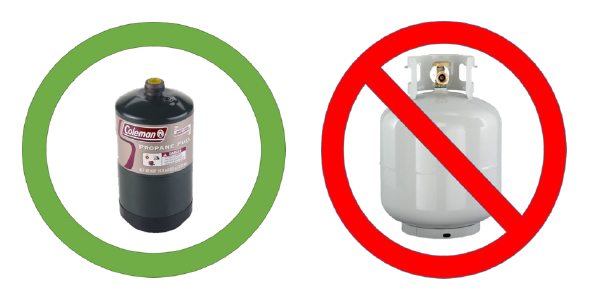
  • LP-gas cooking devices having LP-gas container with a water capacity not greater than 2 1/2 pounds [nominal 1 pound (0.454 kg) LPgas capacity].

Helpful Definitions/Clarifications:

Noncombustible Construction: A material that, under the conditions anticipated, will not ignite or burn when subjected to fire or heat is considered a noncombustible material. Balconies must be rated “noncombustible construction” by the architect/engineer. The use of materials that by themselves are noncombustible does not mean all components and applications meet the standard to allow the use of grills without the presence of a sprinkler system on the balcony.

LP-gas container with a water capacity not greater than 2 1/2 pound: LP-gas containers that are labeled as “16oz 453 g (1LB)”. These are the small canisters that are commonly seen on camping grills and other small portable devices. The use of these grills still need to be located away from combustible items.

If you are not sure if your balcony is combustible or non-combustible materials please consult your property management.

Authorized Use of Open Flame Cooking Devices (Printable PDF)